
Retali’s motto: “Revolution, Passion, Emotion”
CRESCENDO
About events conducted by Giuliana Retali
G.Rossini, Petite Messe Solennelle, Manacor 2.03.2025
G.Rossini, Petite Messe Solennelle, Manacor 2.03.2025
An unusual performance – the chamber music intensity reveals musical structures and details that are otherwise often lost. Very attentive, singer-friendly conducting.
Barbiere di Siviglia, Admiralspalast Berlin 2019
Sensational! I enjoyed yesterday’s performance incredibly… It was no coincidence that the applause was overwhelming.”
Barbiere di Siviglia, Admiralspalast Berlin 2019
Musically an excellent performance by orchestra and performers! A great evening exceeding all my expectations.
Barbiere di Siviglia, Admiralspalast Berlin 2019
For me it was a totally successful performance. The orchestra and singers complemented each other wonderfully and were suitably well rewarded by the audience’s applause.
Barbiere di Siviglia, Admiralspalast Berlin 2019
Everything was super and great. It was a lot of fun. As always the Admiralspalast is splendid. I’m eager to return. Music was amazing! Singers fantastic.
Barbiere di Siviglia, Admiralspalast Berlin 2019
The orchestra and the performers were wonderful. The audience’s spontaneous applause at frequent intervals confirmed this.
Barbiere di Siviglia, Admiralspalast Berlin 2019
Superb singers, a production that concentrates on the essentials, pure musical enjoyment!
Barbiere di Siviglia, Admiralspalast Berlin 2019
We liked the modern staging of the opera very much. Great orchestra, brilliant singers, all in all a beautiful production. The only drawback was that there was no German translation….
Barbiere di Siviglia, Admiralspalast Berlin 2019
It was a wonderful production and a treat for the eyes and ears (with a very good orchestra).
Le nozze di Figaro, Palma de Mallorca, Septiembre 2017
Right on the port of Palma, the Italian conductor Giuliana Retali conducted a performance of the opera which many great and established German opera houses could learn from, indeed, learn a lot from.”
Le nozze di Figaro, Palma de Mallorca, Septiembre 2017
And yet the island has just been the scene of a memorable production of Wolfgang Amadeus Mozart’s opera ‘Le Nozze di Figaro’. This may seem like no record-breaking feat since the composer and his works remain part of the standard repertoire of all opera houses. However what made this performance so special was the fact that it was anything but standard.
Le nozze di Figaro, Palma de Mallorca, Septiembre 2017
When opera is created with such passion, brilliance and coherence… … it is simply sensational….more performances are absolutely called for!
La finta giardiniera, Hannover Septiembre 2016
MOZART IN A FRESH, CRISP AND CLEAR STYLE. Despite its name, the Hanoverian orchestra Musica assoluta in fact plays the role of the opera orchestra. Under the direction of Giuliana Retali, this youthful ensemble plays in an alert and lively fashion, giving Mozart’s score a fresh, crisp and clear quality (…). In addition the absurd finale of the second act gains significantly from the virtuoso impetus that the orchestra contributes.
La finta giardiniera, Niedersächsischen Musiktagen 2016
The conductor was also Italian, the exuberant Giuliana Retali. No wonder then that the locals from Rinteln were swept off their feet by the music and the beautiful voices (…). It was an evening where everything fitted perfectly: the beautiful atmosphere of the church (…) the joyful singing and music-making from all the artists and music itself of the finest quality.
Concierto de Mozart, Manacor Junio 2014
Her interpretation has set new standards and brought about an immediacy I’ve never heard before – it’s as if the instruments are speaking too […]. The resulting energy shows us new, and presumably more accurate, sides of Mozart. I’ve never been so impressed by an interpretation of his work!
Concierto de Mozart, Manacor Junio 2014
It is fascinating how Giuliana Retali succeeds in emotionally spurring on the orchestra. Her conducting technique is outstanding and she is more of a motivator than an old-school, authoritarian orchestral trainer.
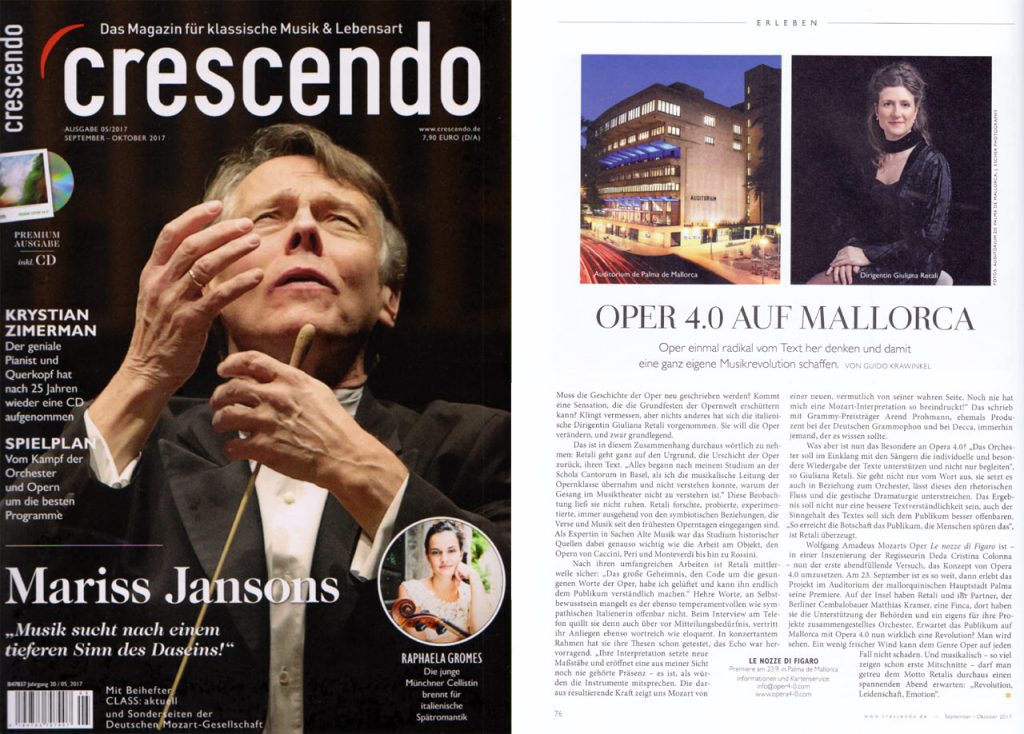
English Translation
Re-thinking opera radically from the text and creating its very own musical revolution-By Guido Krawinkel
Should opera history be written anew? Has a sensation arrived that is capable of shaking the cornerstones of the opera world? It sounds presumptuous, but this is quite simply what the Italian conductor Giuliana Retali has set her sights on. She wants to change opera, and change it fundamentally.
In this context we can take the word ‘fundamental’ quite literally. Retali is going back to the source, back to the original fundaments of opera: its text…
“It all began after my studies at the Schola Cantorum in Basel, when I took over the Musical direction of the Opera class and couldn’t understand why the singing in musical theatre couldn’t be understood”. This observation did not let her rest. Retali researched, tried out and experimented, always starting from the symbiotic relationship that verse and music have had since the earliest days of opera. As an expert in early music, the study of historical sources was just as important as the work on the object, the operas from Caccini, Peri and Monteverdi to Rossini.
After her extensive work, Retali is now certain: “I have unlocked the great secret, the code surrounding the sung words of the opera, and can finally make it understandable to the audience”. Noble words, the exuberant and sympathetic Italian is clearly not without selfawareness.
During the interview on the phone, she is overflowing with the need to communicate and presents her ideas with eloquence and mastery. She has already tested her theses in concert settings, and the response was outstanding. “Her interpretation sets new standards and a new presence that I have never heard before – it is as if the instruments are speaking. The resulting power shows us Mozart from a new, probably his true side. Never before have I been so impressed by a Mozart interpretation!” This was written by Grammy Award winner Arend Prohmann, former producer at Deutsche Grammophon and Decca, someone who should know.
But what is so special about Opera 4.0? “The orchestra should work in harmony with the singers to support the individual and special interpretation of the sung texts and not just accompany them”, says Giuliana Retali. She doesn’t just start from the words, she also places them in relation to the orchestra, supporting and highlighting the rhetorical flow and the gestural dramaturgy. The result should not only be a better understanding of the text, but the meaning of the text should also be better revealed to the audience. “In this way, the message reaches the audience, people feel it”, Retali is convinced.
Wolfgang Amadeus Mozart’s opera Le nozze di Figaro – in a production by director Deda Cristina Colonna – is the first full-length attempt to carry out the Opera 4.0 concept. The premiere will take place on 23 September in the auditorium of the Mallorcan capital Palma. Retali and her husband, the Berlin harpsichord maker Matthias Kramer, have a finca on the island, where they have the support of the authorities and an orchestra put together especially for their project. Is the audience on Mallorca really expecting a revolution with Opera 4.0? It will be seen. In any case, a breath of fresh air can’t do the opera genre any harm. And musically – as the first recordings already show – we can certainly expect an exciting evening, true to Retali’s motto: “Revolution, Passion, Emotion”.
Diario de Mallorca Interview (English Translation)
‘Petite Messe Solennelle’, but it is not small at all.
– True, because it is very complex musically……although it is small in instruments, only three, is complex and difficult…..
What is special about this work?
– I could call it special, because it is unique as far as the instruments are concerned, unique in that respect, but at the same time it is also special because although it is religious music, I understand it as an opera, with its theme, its pathos and its history.
How was the process of preparing this complete work?
– When I thought about this production, I thought that the process would not be so long…
– Think that one of my goals has always been vocalization. A good singer or a good choir must pronounce well in the language they sing and they must also know what the text they are singing says. This is very important…Always, behind any musical text, there is a world, which if you do not understand the language you cannot discover, so the musical result is impoverished.
As a Rossini expert, do you think he knew the text of the Latin Mass well?
– Absolutely. He knew very well what the texts of the ordinary of the Mass say, something that is immediately evident, because he focuses on this or that phrase, always reflecting on what the words say, as in opera. So, I repeat what I said before, that being religious music is at all times at the service of the text.

‘ … which today would be called a MetaRossini: a musical universe that combines
operatic and secular singing with liturgical polyphony. But it must be stressed that
the maestro had in mind, above all, a personal operatic approach to sacred music,
a viewpoint that was wisely taken up by Giuliana Retali’s conducting….
Giuliana Retali’s conducting showed a coherent musical approach, committed to
extreme care for expressive details: rich and flexible dynamics, careful work on
melodic relationships and text, as well as effectively underlining, without excesses,
harmonic and textural changes. His approach to the Petite Messe in its original version
is also relevant, perhaps less performed, but also committed to its essential sonority
and without orchestral fireworks. Retali’s presence in Mallorca has facilitated this
collaboration, but his solid training together with the preparation of a generation of
Mallorcan singers makes possible the stability of artistic offerings of a level that
would have been unthinkable a few decades ago.
Read the article here